Please note this is AI generated content, that was manually queried, and accuracy is not guaranteed. So please read at your own risk. Hopefully it has some useful info, like researching it yourself.
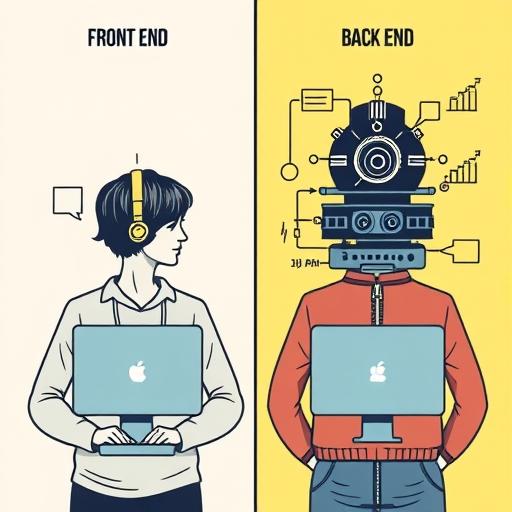
Exploring the roles of Front‑End Developers, Back‑End Developers, Full‑Stack Developers, UI/UX / Product Designers, Graphics / Visual Designers, DevOps Engineers, etc. — how they compare, overlap, and what skills are typical in each area. If you like, I can also turn this into a shorter summary or outline.
Front‑End vs Back‑End vs Full‑Stack vs other related roles
Modern software / web development involves many specialized roles. Each role has its domain, tools, challenges, responsibilities, and expectations. Understanding the differences helps both for hiring and career decisions. I’ll first define front‑end, back‑end, full‑stack, then compare with adjacent roles: UI/UX design, graphic design, devops, software engineering more broadly.
What are Front‑End, Back‑End, Full‑Stack?
Front‑End Developer
Definition / Scope
A front‑end developer builds the part of a web application or site that users see and interact with. This includes interface layout, styling, interactivity, responsiveness, user input, rendering UI, forms, animations, ensuring compatibility across browsers/devices etc. ComputerScience.org+3GeeksforGeeks+3HackerRank+3
Typical technologies / tools
- Languages: HTML, CSS (including preprocessors like SASS, LESS), JavaScript (and possibly TypeScript) HackerRank+2GeeksforGeeks+2
- Frameworks / libraries: React, Angular, Vue, Bootstrap, Tailwind, jQuery, etc. HackerRank+1
- Tools: build tools/ bundlers (Webpack, Vite), version control (Git), CSS frameworks, responsive design tools, browser dev tools, performance / debugging tools. GeeksforGeeks+2HackerRank+2
Key responsibilities
- Translating UI/UX design into working code.
- Ensuring good user experience: page load speed, accessibility, responsiveness, cross-browser / cross-device compatibility. GeeksforGeeks+2Forbes+2
- Interactivity: handling user input (clicks, forms), dynamic content.
- Optimizing performance on the client side.
Challenges
- Keeping up with many front‑end frameworks / JS ecosystem changes.
- Ensuring design consistency, cross‑browser quirks.
- Balancing visual appeal with performance.
Typical salary / demand
Front‑end roles are very in demand. Salaries vary depending on region, experience, etc. Some sources put average US front‑end dev compensation around US$80,000‑90,000/year (or more) depending on seniority and location. HackerRank+3ComputerScience.org+3Coursera+3
Back‑End Developer
Definition / Scope
Back‑end devs build the server‑side logic: databases, APIs, application logic, server management, data storage, security, business rules. They ensure that when the front end requests data, everything behind works reliably, securely, and efficiently. HackerRank+2Indeed+2
Typical technologies / tools
- Languages: Java, Python, Ruby, Node.js, Go, C#, PHP etc. HackerRank+2Amazon Web Services, Inc.+2
- Databases: SQL (PostgreSQL, MySQL), NoSQL (MongoDB, Cassandra etc.) GeeksforGeeks+1
- Server frameworks: e.g. Django, Rails, Express, Spring, .NET, Laravel etc.
- Additional tools: API design, version control, testing, security, caching, performance optimisation, managing concurrency, load balancing. Amazon Web Services, Inc.+2HackerRank+2
Key responsibilities
- Designing, implementing, and maintaining APIs and server‑side services.
- Managing data: storage, queries, integrity, optimizing database performance.
- Ensuring reliability, scalability, security.
- Handling server infrastructure, sometimes deploying and monitoring etc.
Challenges
- Scaling services, maintaining performance under load.
- Handling data consistency, backups, migrations.
- Security issues: authorization, authentication, protecting sensitive data.
Typical salary / demand
Generally, back‑end devs often earn slightly more (on average) than front‑end devs, reflecting the complexity of systems, though this gap depends heavily on location, experience, domain. Some sources report US back‑end developer averages near US$90,000‑110,000+ or more. GeeksforGeeks+2Forbes+2
Full‑Stack Developer
Definition / Scope
A full‑stack developer is someone who works across both front‑end and back‑end: able to build a complete web application from the UI to the server logic, databases, APIs, sometimes infrastructure. They might specialize in one end more, but have capability in both. Coursera+2ComputerScience.org+2
Typical skills / tools
- All of front‑end stack + back‑end stack.
- Understanding of how front‑end and back‑end interact (APIs, data flow).
- Tools, frameworks covering both sides.
- Sometimes also basic deployment / hosting / DevOps knowledge.
Advantages / Trade‑Offs
- Advantage: flexibility, able to understand end-to-end system; can prototype quickly; useful in small teams / startups.
- Trade‑off: might be less deep in some specialised areas; may have to spread effort across many technologies.
Demand
High demand in smaller teams or companies needing lean staffing. Salary tends to be competitive, often similar to or somewhat above specialist roles depending on expertise. HackerRank+2ComputerScience.org+2
Other Related Roles
To fully appreciate the ecosystem, here are adjacent but distinct or overlapping roles:
| Role | Primary Focus / Responsibilities | Key Skills / Tools | Where Overlaps / Distinctions |
|---|---|---|---|
| UI Designer / Visual Designer | Create visual look & feel: color, typography, layout, imagery, branding. Mockups / design systems. | Graphic tools (Sketch, Figma, Adobe XD, Photoshop, Illustrator), prototyping, branding style, color theory. | Overlaps with front‑end: front‑end implements the designs. UI designers usually do not code heavily. Distinct from UX (which focuses on usability, user research). |
| UX Designer / Researcher | Focus on user experience: usability, information architecture, user flows, wireframes, prototypes, testing with users. | Research methods, wireframing tools, prototyping, usability‐testing, interaction design. | UX influences how front‑end is built; sometimes front‑end devs do UX tasks, especially in smaller teams. But UX tends to be non‑coding or lightly coded (prototypes) rather than full production code. |
| Product Designer | A hybrid role: often combines UX + UI + sometimes front‑end implementation, with attention to product goals, strategy. | Mix of UX & UI skills, business understanding, prototyping, design systems. | Product designers may cross into front‑end‑/UX writing; sometimes code a bit, but not always. |
| Graphics / Visual / Motion Designers | Specialised in creating assets: logos, icons, illustrations, motion graphics / animations. | Illustrator, Photoshop, After Effects etc., vector graphics, animation tools. | Less involved with code; deliver assets to UI / front‑end devs. In some cases, motion designers may embed interactive/external animations. |
| Software Engineer / Backend Engineer (wider scope) | In larger systems (not just web), work on algorithms, architectures, performance, distributed systems, etc. Could be embedded, mobile, platform engineering. | Strong CS fundamentals: data structures, algorithms, system architecture, concurrency, possibly languages like C++, Rust etc. | Overlaps with back‑end web dev; but can be more general. Full‑stack likely less deep in these system‐level concerns. |
| DevOps / SRE (Site Reliability Engineer) | Responsible for infrastructure: CI/CD pipelines, deployment, monitoring, reliability, scaling, availability, performance, sometimes security + operations. | Tools like Docker, Kubernetes, Terraform; cloud platforms (AWS, GCP, Azure); monitoring tools; scripting & automation; logging, metrics. | Overlaps with back‑end & sometimes full‑stack in small teams. Usually less design/UI; but increasingly they work closely with front‑end and UX for performance, load times, user‑facing issues. |
Comparisons & Overlaps
Here are important comparisons, and where roles often overlap or blur.
Overlaps
- Front‑end & UI/UX: UI/UX designers create mockups, wireframes; front‑end devs translate them into working interfaces. Understanding by front‑end devs of design principles helps; sometimes front‑end devs do small UI & UX tasks (especially in smaller teams).
- Full‑Stack & DevOps: Full‑stack devs might do deployment, basic server setup; but devops specialists go much deeper. If you’re a full‑stack dev in a startup, you may take on devops responsibilities.
- Software Engineers & Back‑End: Back‑end in web is a kind of software engineering; but software engineering more broadly includes non‑web, low‑level, embedded, performance‑critical, distributed systems etc.
Where roles differ significantly
- Depth vs Breadth: Specialists (front‑end, back‑end, UX, devops) go deep in one area. Full‑stack or product designers may be broader, less deep in each specialization.
- Coding vs Non‑Coding: UI/UX designers often don’t code (or do minimal / prototyping). Back‑end devs, front‑end devs code heavily. Graphics designers even less so.
- User‑facing vs behind the scenes: Front end & UI/UX are user facing; back end, devops, systems are behind the scenes, but critical for performance, security, scalability.
- Tools / skills differ significantly. Understanding both sides can be a big advantage (e.g. front‑end dev familiar with server constraints, or UX designer aware of performance penalties of certain UI choices).
Which Role Should You Choose / What’s Right for You
Here are some factors to consider if you’re choosing what to specialize in, or thinking about moving between roles.
| Factor | Points to think about |
|---|---|
| Personal strengths | If you love design, visuals, interaction, user psychology → UI/UX or front‑end. If you enjoy logic, algorithms, data modelling, performance, system architecture → back‑end or devops. If you enjoy working across the stack, solving both design & technical problems → full stack / product designer. |
| Learning curve | Front‑end: many frameworks, browsers, CSS intricacies; back‑end: systems, databases, security; devops: infrastructure, reliability; UX: research, human factors. |
| Impact | Front end tends to be what users see first; back end tends to affect scale, reliability, data integrity; devops affects stability and uptime; UX affects how usable / enjoyable product is. |
| Career growth | Specialist roles can lead to seniority in that domain; full‑stack can lead into leadership (product, tech leads) or roles where oversight of multiple domains is required; devops / infrastructure roles are in strong demand especially as apps scale. |
| Demand / compensation | All roles are in demand. Compensation tends to be higher for those with rare skills (e.g. devops, distributed systems, security) or those combining skills effectively. Location, experience, industry vector matter a lot. |
Example Role Descriptions (What a Day Might Look Like)
To make this more concrete, here are what typical responsibilities might look like for each role in a mid‑sized product team.
- Front‑End Developer
Morning: attend stand‑up, review designs / design system updates. Work on new feature UI: code the layout, style it, make sure it’s responsive. Run into a browser compatibility bug, test & fix. Integrate with API provided by back‑end. Optimize performance (e.g. lazy loading, minifying). Collaborate with UX designer: feedback on usability, tweaking visuals. - Back‑End Developer
Morning: maybe working on API endpoint to support a new feature. Design database schema, write migrations. Ensure input data is validated, write business logic. Work on performance optimisations or caching strategy. Monitor server logs for error rates. Perhaps fix bugs. Coordinate with front‑end about how data is supplied. - Full‑Stack Developer
Might switch between front‑end and back‑end tasks: build small UI for a feature, then write or extend its API, test end‑to‑end. Sometimes help deploy or configure staging server. Bridge understanding between design, front end, and back end. - UI/UX Designer
Research users: run interviews, review analytics to see pain points. Create wireframes, prototype flows. Design high‑fidelity mocks. Work on design system: define reusable components, style guide. Hand off designs to front‑end dev, review implementation. Usability testing, A/B testing, gathering feedback. - Graphics / Visual / Motion Designer
Create brand assets: logo, iconography, illustrations. Possibly design animations, transitions. Create assets for marketing, backgrounds, banners, etc. Work with UI designers to ensure consistency. Might rarely code, but need to understand formats / sizing etc. - DevOps / SRE
Maintain CI/CD pipelines, ensure deployments happen smoothly. Monitor system health, uptime, error rates, performance. Manage infrastructure (maybe cloud servers, containers, orchestration). Automate tasks (log rotation, backups, scaling). Security concerns: access control, vulnerability scanning. Coordinate with other devs to enable more frequent releases.
Trends / Changes in the Industry
These roles aren’t static. Some emerging trends:
- DesignOps / DevOps / UXOps: As products scale, the operations around design and user‑experience are becoming more formalized (just as DevOps formalized operations). Tools, workflows, pipelines for design artifacts, version control, design systems are more important.
- Bridging roles / hybrids: Roles like UI/UX Engineers (design + front end code), Product Designers, fullstack engineers who also do some infra/devops. Companies often expect more breadth even in specialists (for example, front‑end devs knowing something about performance/security, back‑end devs knowing about front‑end constraints).
- Emphasis on accessibility, performance, security across all roles. UX designers, front‑end devs, and devops engineers all share responsibility. Design choices have consequences for performance; infrastructure choices affect user experience (e.g., slow back‑end = bad UX).
- Tooling & automation: Better tools for prototyping, design hand‑off, testing, continuous deployment. More use of frameworks, component systems, design tokens, etc.
- Cloud & microservices / serverless architecture: This tends to shift some back‑end / devops work; more distributed systems. Full‑stack and devops roles must handle more complexity in deployment, monitoring, scaling.
Summary
- Front‑end devs: focused on what user sees & interacts with; strong in UI, visual design implementation; working with HTML, CSS, JS, frameworks.
- Back‑end devs: focused on server‑side logic, data, APIs, performance, security.
- Full‐stack devs: combine both front and back, more breadth, less specialization; very useful especially in smaller teams.
- UI/UX / Product / Graphic Designers: more focused on design, user research, visual assets; less coding (mostly). Their work is essential to user satisfaction and usability.
- DevOps / SRE: ensure reliability, performance, deployment, infrastructure, operations. Crucial as systems scale.
References & Sources
Here are some useful sources I used / you might want to check out for more depth:
- Front End vs Backend Development ‒ GeeksforGeeks GeeksforGeeks
- Front‑End vs Back‑End Developers: What’s The Difference? ‒ Forbes Advisor Forbes
- Front‑End vs Back‑End vs Full‑Stack Developers ‒ HackerRank Blog HackerRank
- What Does a Back‑End Developer Do? / Front‑End Developer Skills – AWS comparisons etc. Amazon Web Services, Inc.+1
- UI/UX Designer vs UX/UI Developer: What’s the Difference? ‒ FrontTribe fronttribe.com
- Other design role distinctions (UX researcher, product design etc.) ‒ Merveilleux.design article on SaaS UX roles merveilleux.design